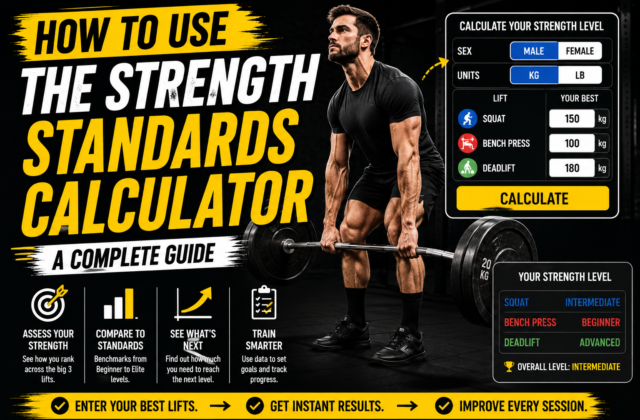
The Strength Standards Calculator shows you which strength tier Beginner, Novice, Intermediate, Advanced, or Elite you’re in for a given lift, based on your bodyweight. It’s one of the most-used tools on this site, largely because “am I actually strong for my size” is one of the most common questions lifters have and one of the hardest to answer without a reference point.
Step-by-step: how to use the calculator
- Choose your sex.
- Choose a lift — squat, bench press, or deadlift.
- Toggle kg or lb.
- Enter your bodyweight and your best lift for the one you selected.
You’ll see your current tier, your exact ratio (lift ÷ bodyweight), and the specific weight needed to reach the next tier up.
How the tiers are built
Rather than a flat number that would treat every lifter the same regardless of size, these standards are expressed as a multiple of your own bodyweight — for example, an intermediate squat sits around 1.5× bodyweight for men, while an intermediate deadlift sits closer to 2×. This scales the benchmark to you personally rather than forcing a 60kg lifter and a 120kg lifter onto an identical absolute bar.
The five tiers, roughly: Beginner (your first few weeks of barbell training), Novice (3–6 months of consistent training, still making rapid week-to-week progress), Intermediate (roughly 1–2 years in, the point where most lifters plateau into needing real programming instead of simple linear progression), Advanced (several years of focused, well-programmed training), and Elite (the top tier of dedicated lifters, typically reached only after years of consistent, well-executed work).
How fast should you expect to move through the tiers?
Progress through these tiers is naturally fastest at the beginning and slows substantially as you advance — a new lifter can often move from Beginner to Novice in a matter of weeks, while the jump from Advanced to Elite can take years of dedicated, well-programmed training even for genetically favorable lifters. This isn’t a flaw in the chart; it reflects how adaptation actually works. Early training exploits “newbie gains” that are unavailable once your body has adapted to the basic stimulus of lifting, so don’t expect the pace of your first few months to continue indefinitely.
What these numbers are — and clearly aren’t
These are general population benchmarks aggregated from public strength-standards data across large numbers of gym-going lifters — not from a controlled scientific study, and not an official federation or competition standard. They’re a useful compass for “roughly where do I sit,” not a precise instrument, and they say nothing about your specific training age, injury history, limb lengths, or which lifts you’ve actually prioritized in your training. It’s completely normal — and doesn’t indicate anything is wrong — to be Advanced on deadlift while still Novice on overhead press; different lifts respond to different amounts of dedicated practice and reward different individual leverages.
The most useful way to actually use this tool
The single most valuable thing a strength standard does isn’t tell you which label applies to you today — it’s show you the specific weight needed for the next tier up, giving you a concrete, motivating target instead of an abstract goal like “get stronger.” Chase the next number on the chart, not the label itself, and treat your current tier as a snapshot rather than a fixed identity.
Common mistakes to avoid
- Comparing your tier directly to a training partner’s without accounting for bodyweight differences — the whole point of the ratio system is that raw lift numbers alone aren’t comparable across bodyweights.
- Treating a “Beginner” or “Novice” result as discouraging rather than as an accurate, useful starting point — every advanced and elite lifter started in exactly the same place.
- Using outdated bodyweight or lift numbers — recheck periodically as both change over a training career.
Frequently asked questions
Are these standards the same for men and women?
No — the multipliers differ by sex, reflecting real average differences in the strength-to-bodyweight relationship between the datasets each is built from.
Do these apply to raw or equipped lifting?
These standards assume raw (unequipped, aside from a belt and basic supportive gear) lifting — equipped numbers would sit meaningfully higher across every tier.
Should beginners use this to set training goals?
Yes, this is one of the best uses of the tool — pick the next tier up as a concrete medium-term target rather than training toward a vague, undefined goal.
What if I’m right on the boundary between two tiers?
Treat it as belonging to the lower tier until you’ve comfortably exceeded the threshold — a single good day that just crosses a line isn’t the same as being reliably established at that level.
Does bodyweight change affect my tier even if my lift stays the same?
Yes — because these standards are ratios, gaining or losing bodyweight shifts your tier even with an unchanged lift number, which is worth remembering if you’re cutting or gaining weight around a competition.
Where to go next
Read the full explanation in Strength Standards Explained, or check a single lift directly with the Squat, Bench, or Deadlift calculators.