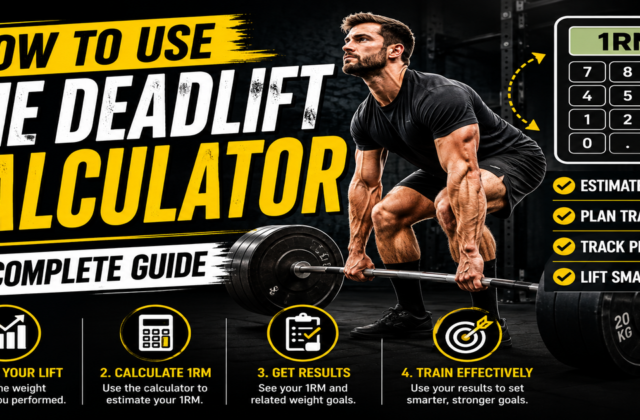
The Deadlift Calculator is a focused, single-lift version of the Strength Standards Calculator — just the deadlift, nothing else to fill in, for anyone who only wants a quick answer on this one lift.
Step-by-step: how to use the calculator
- Choose your sex.
- Toggle kg or lb.
- Enter your bodyweight and your best deadlift.
You’ll see your current tier — Beginner through Elite — plus the exact weight needed to reach the next tier up.
Why deadlift standards tend to run higher than squat or bench
Deadlift typically has the highest bodyweight-ratio standards of the three competition lifts, and several factors combine to explain why. The range of motion is generally shorter for most lifters than a full-depth squat. There’s less technical complexity in balance and bar-path control compared to squatting under load. And critically, the deadlift is fundamentally grip- and back-limited rather than balance-limited — once you’re strong enough to hold and hip-hinge the weight, there’s less of a stability ceiling capping how much load you can move compared to a lift that requires controlled descent and ascent through a full squat.
Don’t be discouraged if your deadlift tier looks noticeably more advanced than your squat or bench tier on this same chart — that’s an extremely common, entirely normal pattern across most lifters, not a sign that something is wrong with your squat or bench training specifically.
Grip strength: often the real limiting factor
For many lifters, especially as weights get heavy, the deadlift stops being limited by the back and legs and starts being limited by grip. Double-overhand grip typically fails first, which is why mixed grip (one hand over, one under) and hook grip (thumb trapped under the fingers) exist as techniques specifically to remove grip as the bottleneck and let your actual posterior-chain strength be the limiting factor instead. If you find your deadlift numbers plateauing well below what your back and legs feel capable of, grip technique and grip-specific training are often the fastest lever to pull before assuming you need more general strength work.
Sumo vs conventional: does stance affect the standard?
These standards don’t distinguish between sumo and conventional deadlift stance — both are valid competition variations, and neither is inherently “worth less” for strength-standard purposes. If your gym or federation records only one style, use whichever total you actually pull, regardless of stance.
Straps, mixed grip, and hook grip: does grip style matter here?
Grip style affects how much weight you can hold onto, but not how these bodyweight-ratio standards are calculated — the chart simply uses your best successful pull, however you gripped it (within competition-legal limits; see the note on straps below). That said, grip is very often the actual limiting factor on a deadlift long before your back or legs give out, which is why mixed grip and hook grip exist as techniques specifically to let hand strength stop being the bottleneck. If your deadlift feels capped by your grip rather than your posterior chain, that’s a technique and grip-strength issue to address in training, not a sign your standards-chart tier is inaccurate.
What this tool doesn’t account for
Limb length matters enormously for deadlift specifically — lifters with proportionally shorter arms and a shorter torso relative to their legs often have a substantial leverage advantage on this lift compared to lifters built the opposite way, independent of actual muscular strength. Two lifters with identical training histories and comparable overall strength can post meaningfully different deadlift numbers purely due to build. Use this calculator as a general benchmark, not a precise measure of “how hard you’ve trained” in isolation.
Common mistakes to avoid
- Comparing your deadlift tier directly against someone with very different limb proportions and assuming the gap reflects only training difference.
- Using a lift that wouldn’t pass standard competition depth/lockout rules (full lockout, hips and knees extended) as your input — this can inflate your result relative to what you’d actually total in a meet.
Frequently asked questions
Is sumo “cheating” for strength standards purposes?
No — sumo is a legal, widely-used competition stance, and these standards apply to your actual best deadlift regardless of stance.
Why is my deadlift standard so much higher than my bench standard?
This is expected and normal — see the explanation above on why deadlift standards run higher across the board, not just for you specifically.
Do straps count for these standards?
Standard competition rules don’t permit straps in most raw federations; if your best pull used straps, keep in mind your competition-legal number (without straps) may be somewhat lower.
Does deadlift stance (sumo vs conventional) ever get tracked separately in official records?
Some federations and record-keeping databases do log stance separately for record-tracking purposes, even though the general strength-standards tiers here don’t distinguish between them.
Where to go next
Want squat and bench standards too? Use the full Strength Standards Calculator, or check Squat and Bench individually.